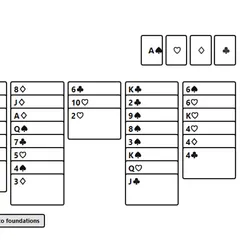
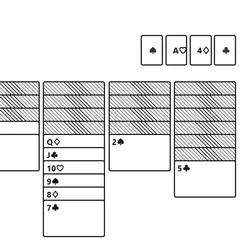
Sort two decks into eight single-suit runs from King down to Ace, with one, two or four suits to set the difficulty.
Spider Solitaire is a long patience game for one player, played with two full decks. The cards are spread across ten columns, and your task is to sort them into eight runs that go all the way from King down to Ace, each in a single suit. It rewards patience and planning more than speed.
Before each deal you choose how many suits to use. One suit is gentle, two is the standard game and four is hard work.
The deal and the rules
Fifty-four cards are dealt into the ten columns. The four columns on the left get six cards, the other six get five, and only the bottom card in each one is face up. The remaining fifty cards wait in the stock.
You may place any card on a card exactly one rank higher, in any suit. A 9 of spades can go on a 10 of hearts, for example. Moving several cards together is stricter, because the group must already be a falling run in one suit. A mixed run has to be taken apart card by card. Any card or valid run can go into an empty column.
When to deal
Tapping the stock lays one face-up card on every column, and you get five of these deals. The game refuses to deal while a column is empty, so fill it first. Whenever one suit lines up all the way from King to Ace at the bottom of a column, it leaves the table by itself, and the counter at the top rises. Reach 8 of 8 and you win.
Strategy notes
- Build in suit when you have the choice. Same-suit runs can move as a block later.
- Guard empty columns. They let you break up a mixed run one card at a time.
- Turn over face-down cards early, especially in the deep left columns.
- Use every useful move before you deal, since a deal drops a card on top of everything.
Picking a difficulty
If you are new to Spider, start with one suit. Every card can join every run, so you learn how deals and empty columns work without much pressure. With two suits, you must stop hearts and spades from mixing, and four suits makes long same-suit runs rare.
You can play with a mouse, by touch or with the keyboard, using the arrow keys to move and Enter or Space to pick up and drop cards. Undo has no limit, which makes it easy to try an idea and back out of it.
Controls
| Action | Keyboard | Mouse | Touch |
|---|---|---|---|
| Pick up a card or same-suit run | Arrow keys to move between cards, then Enter or Space | Click the card | Tap the card |
| Drop the selection on a column | Arrow keys to the column, then Enter | Click the column | Tap the column |
| Deal ten new cards | — | Click the stock pile (it shows the deals left) | Tap the stock pile |
| Undo the last move or deal | — | Click "Undo" | Tap "Undo" |
| Choose suits and start over | — | Pick 1, 2 or 4 suits, then click "New game" | Pick 1, 2 or 4 suits, then tap "New game" |
Spider Solitaire FAQ
Does Spider Solitaire save my game?
Yes. Your browser holds on to the current deal, so you can close the tab and come back to the same layout later on that device. Undo also works without limit during a session, covering both moves and deals.
Can I play it on a Chromebook or phone?
Yes. It works with a mouse, a touchscreen or the keyboard. All ten columns fit side by side even on a small phone, though the cards get narrow there, so turning the phone sideways helps a little.
How long does a game usually take?
A full game is fairly long, since you need to sort all 104 cards. One-suit games tend to go faster because any card can join any run. Four-suit games take the most time and thought. A move counter shows how much work you put in.
What should I do when I run out of moves?
First check every column for a card that can go one rank lower, and look for runs you can split. If nothing helps, tap the stock to deal ten new cards. Remember the stock will not deal while any column is empty.