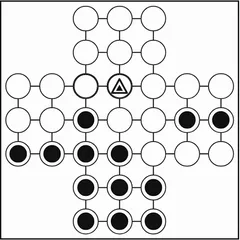
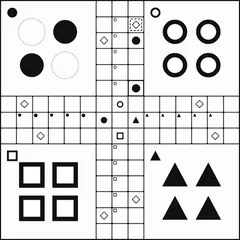
Four tigers against twenty goats on a grid of lines. Hunt as the tigers or trap them as the goats.
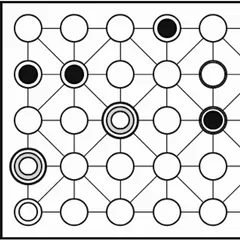
Bagh-Chal is a two-sided strategy game from Nepal in which one player controls four tigers and the other controls twenty goats. The board is a five-by-five grid of lines, and pieces sit on the points where lines meet. The tigers begin on the four corners. The goats start off the board and enter one at a time.
What makes it interesting is that the two sides play completely different games. The tigers are hunters. The goats cannot hurt anyone, so they win by teamwork and position alone.
The goal
Tigers need five captures to win. Goats need to trap all four tigers so tightly that none of them can make a move. If the side whose turn it is has nothing legal to do, that side has lost.
A tiger captures by leaping over a goat that stands right beside it along a line, landing on the open point on the far side. The jumped goat leaves the board. Jumping is always optional, so a tiger can choose a quiet step instead.
How a game unfolds
Play happens in two stages. During the first, the goat player drops a new goat on any empty point each turn, while the tigers are already free to move and jump. That stage runs until all twenty goats have arrived.
After that, both players move by sliding one piece a single step along a line to an open neighboring point. Horizontal and vertical lines join every point, but diagonals only run through some of them. Before you plan a slanted move or jump, check that a diagonal line is actually drawn there. A tracker below the board shows how many goats have been placed and how many have been taken.
Strategy notes
As the goats, start on the outer edge. A goat with the border behind it cannot be jumped from that side. More generally, a goat is only in danger when the point directly behind it is empty, so close those gaps before you advance. Try to split the tigers up, since a group of tigers keeps escape routes open for one another.
As the tigers, head for the center. That point has the most lines leading out of it, so it gives you the widest choice of steps and threats. Your best chance to score is early, while goats are still entering and the board is full of holes.
Choosing a level
The computer comes in Easy, Medium and Hard. Easy moves at random, Medium thinks a single turn forward, and Hard reads a number of turns into the future. If you are new, try the tigers first, then switch to the goats once you understand how captures happen. A Settings option can also highlight which of your pieces are able to move.
Controls
| Action | Keyboard | Mouse | Touch |
|---|---|---|---|
| Place a goat | Arrow keys to reach a point, Enter to place | Click an empty point | Tap an empty point |
| Move or capture | Arrow keys and Enter to pick the piece, then the target point | Click your piece, then the point it should go to | Tap your piece, then the target point |
| Start a game against the computer | — | Click "vs Computer", choose goats or tigers and a level, then click "New game" | Tap "vs Computer", choose goats or tigers and a level, then tap "New game" |
| Take back a move | — | Click "Undo" | Tap "Undo" |
| Show which pieces can move | — | Turn on "Show move suggestions" in Settings | Turn on "Show move suggestions" in Settings |
Bagh-Chal FAQ
Is Bagh-Chal one or two players?
Either. Choose "vs Computer," pick a side and a level, and the computer plays the other role. You can also play two people on one device and take turns with the same mouse or screen.
Can I play it on a phone or Chromebook?
Yes. Every point on the board reacts to a tap, so phones and tablets work well. On a Chromebook you can click, or move around the board with the arrow keys and press Enter to place or move a piece.
Does my game stay if I reload the page?
It does. A game in progress is saved in your browser and survives a reload. You also have Undo to take back a move and Resign if you want to give up and start over.
What is the win condition for each side?
The tigers win once they have taken five goats. The goats win by leaving the tigers with no legal move at all. In general, any side that has nothing legal to play on its turn loses the game.