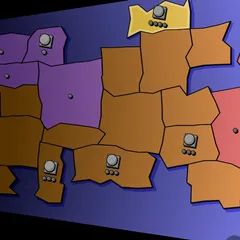
Red links top to bottom, Blue links left to right. Whoever finishes an unbroken chain first takes the game.
Hex is a board game about building a bridge across the board before your rival does. The playing field is a 9x9 diamond made of hexagon cells. Red owns the top and bottom edges, and Blue owns the left and right ones. Players take turns placing stones, and the first to connect their two sides with an unbroken chain wins.
That is the whole rule set. There are no captures and no moving pieces. Even so, the game gets deep quickly, because stopping your opponent and finishing your own path are really one and the same task.
How a game works
Red always takes the first turn. After that, each player adds one stone of their color to any empty cell. Once placed, a stone stays put for good.
Each cell has six neighbors, so chains can twist and turn as much as they need. When a full path of touching stones links one player’s edges, the game ends and names the winner. A legend below the board reminds you who owns which sides.
Why there are no draws
Red’s route and Blue’s route run across each other, so both players can’t fail at once. If the board ever filled up, the stones that block one side would form a winning chain for the other. Every match ends with a winner, often long before the board is full.
Strategy notes
- Claim the middle. A stone near the center can stretch toward both of your sides and is tough to cut off.
- Learn the bridge. When a pair of your stones share two empty neighbors, no one can split them. If your rival takes one gap, take the other.
- Block early, not up close. Blocking directly beside a rival chain rarely works, since it simply bends around you. Put your blocker a few rows ahead of it.
- Don’t hug the edge. Stones along the border do less work than central stones that threaten several routes.
- Mind the sharp corners. The diamond’s two sharp tips are where tight connections are often decided late.
Choosing your opponent
Before a match, pick Red or Blue and set a level. Easy places stones at random. Medium counts the stones both players still lack for a full link and picks from its top options. Hard looks a few moves ahead at the most promising cells. Moving first is a real edge, so taking Blue is the tougher challenge. Settings also let you change text size, contrast, spacing and how fast the computer replies.
Controls
| Action | Keyboard | Mouse | Touch |
|---|---|---|---|
| Place a stone | Tab to the board, arrow keys to pick a cell, Enter to place | Click an empty hexagon | Tap an empty hexagon |
| Choose color and opponent | — | Pick Red or Blue and a level, then click "New game" | Pick Red or Blue and a level, then tap "New game" |
| Take back a move | — | Click "Undo" | Tap "Undo" |
| Give up | — | Click "Resign" | Tap "Resign" |
Hex FAQ
Does Hex work on a phone or Chromebook?
Yes. Tap any free hexagon to drop a stone on a phone or tablet, and the board fits either orientation. On a Chromebook, click with the mouse, or press Tab to reach the board, then use the arrow keys and Enter.
Can I play against a friend?
Yes. Hex supports a local two-player mode where you share one screen and take turns. If you are alone, pick Red or Blue and choose an Easy, Medium or Hard computer opponent instead.
How long does a game of Hex take?
Games are fairly quick. The board has 81 cells, and a winning chain usually forms well before they are all used. Your game in progress is saved, so you can close the page and finish later.
What should I do if the computer keeps beating me?
Try playing Red, since the first move is a big edge and there is no swap rule. Use Undo to test different replies, and practice the two-stone bridge shape, which can't be cut.