Fit twelve five-square shapes, each named for a letter, into a rectangle so that every cell is covered once.
Five-Square Tiling Puzzle hands you a set of flat shapes and an empty rectangle. Each shape is made of five squares joined along their edges, and there are twelve possible shapes in all. Their names come from letters they resemble, so you will meet shapes called X, Z, T, L, F and more. You fit them together until the rectangle is fully covered.
It sounds simple until the final two pieces refuse to go in. Every piece also carries a black-and-white pattern, so you can tell them apart without relying on color.
Getting started
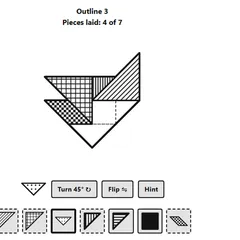
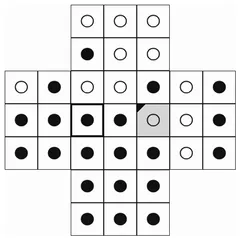
Choose a piece from the tray under the board. A copy shows up next to two buttons, Turn and Flip, and one of its squares carries a marker dot. Rotate or mirror it until it faces the way you want, and tap the cell on the board where the marked square belongs. To remove a piece, tap it on the board and it returns to the tray.
You win when every cell of the rectangle is covered exactly once. A counter keeps track of how many pieces are down.
Two ways to play
In Free laying, no particular answer is required, so any full cover wins. The Easy board is a square five cells wide built from five shapes. Medium stretches to eight cells long with eight shapes. Hard brings in the whole set of twelve on a field you choose, from a 6 by 10 block down to a narrow strip three cells tall and twenty long, with 5 by 12 and 4 by 15 in between.
Start pieces given is stricter. Some pieces are already fixed on a 6 by 10 board, and you must add three, five or seven more. Only one arrangement works, so it plays more like a logic puzzle.
Winning moves
- Work from the border inward. Pieces such as U, L and I, which have long flat sides, hug the edge nicely and leave a cleaner middle.
- Place the X early. The plus-shaped piece demands room in every direction around its middle square, which gets harder to find as the board fills.
- Count empty cells. A pocket whose size is not a multiple of five can never be filled. Fix it before laying anything else.
- Mirror before giving up. N, F and Z look quite different when flipped, and the other side may be the one that fits.
Why it’s worth a try
This is a quiet thinking puzzle with plenty of range. The easy boards are gentle, while the narrow 3 by 20 field allows so few layouts that it can keep you busy much longer. The hint system means you never stay stuck for good, and you can still solve each board yourself.
Controls
| Action | Keyboard | Mouse | Touch |
|---|---|---|---|
| Choose a piece | Tab to the piece in the tray, then Enter | Click the piece below the board | Tap the piece below the board |
| Turn or flip the chosen piece | Tab to "Turn" or "Flip", then Enter | Click "Turn" or "Flip" | Tap "Turn" or "Flip" |
| Lay the piece | Tab to the square where the piece's dot should go, then Enter | Click the square where the piece's dot should go | Tap the square where the piece's dot should go |
| Lift a laid piece | — | Click the piece on the board | Tap the piece on the board |
| Ask for help | — | Click "Hint" | Tap "Hint" |
Five-Square Tiling Puzzle FAQ
Can I play Five-Square Tiling Puzzle on a phone?
Yes. It works entirely with taps, so there is no dragging on a small screen. You pick a piece, turn or flip it with buttons, then tap where it should go. A mouse or keyboard works too on a Chromebook or computer.
Is my board saved if I leave?
Yes. The puzzle you are working on is kept in your browser and comes back after a reload, so you can stop partway through a hard board and finish it later.
What should I do when I get stuck?
Press Hint. It points to the correct spot for one of your remaining shapes, based on an answer that works with what you have placed so far. When an earlier placement has ruined the board, it names that piece so you can lift it out.
Which mode should a beginner try first?
Start with Easy in Free laying, which uses five pieces on a 5 by 5 square. Any filling counts there. Move on to Medium with eight pieces, then Hard with all twelve, or try the fixed-start puzzles when you want one exact answer.